Kitchen Exhaust Cleaning in Vaughan
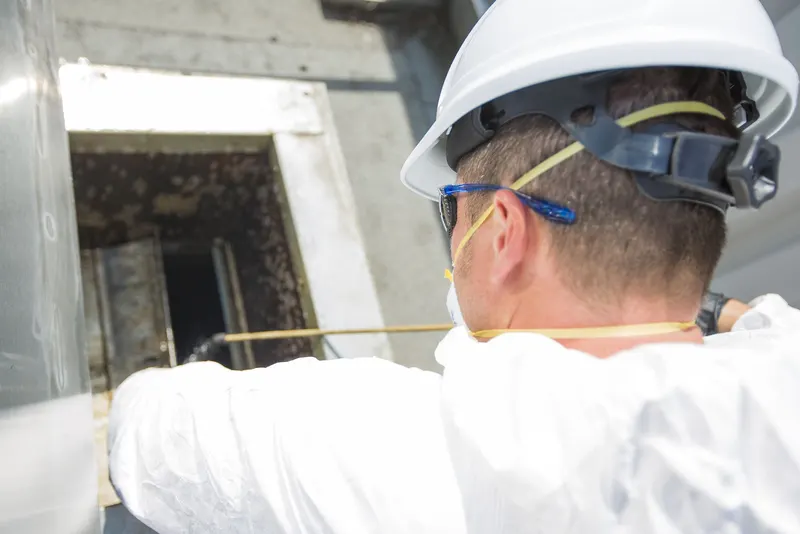
Kitchen Exhaust Cleaning in Vaughan is the cleaning of the grease duct that carries cooking air from the hood collar to the rooftop fan: the horizontal run above the ceiling, the vertical riser through the building, and the access panels that make each section reachable. Vaughan Hood Cleaning Pros opens the run at every panel, scrapes each section to bare metal, checks the NFPA 96 grease limit of 0.078 inches along the whole path rather than at the hood alone, and lists every section on a signed certificate referencing the published standard. Where several kitchens share one riser, the quote says who owns which section.
Horizontal run, riser, access panels: the three sections of a kitchen exhaust duct
The horizontal run leaves the hood through the duct collar and travels above the ceiling toward the shaft. Grease settles on the floor of the duct as the air slows and piles up on the outside wall of every elbow, where the airstream is thrown against the metal.
The riser is the vertical section up to the fan. Whatever condenses on its walls runs back down and pools in the turn at its base. A riser inspected from the roof looks clean while its foot holds the heaviest layer.
Access panels are sealed, removable openings in the duct wall. Fitting compliant panels where a run is blind is priced on the quote before the visit. The canopy, filters and plenum are on the hood cleaning services page, and the fan on the exhaust fan repair page.
Hood-only vs full-system kitchen exhaust cleaning in Vaughan
The two scopes read very differently when an inspector or an insurer asks for the record.
| The question the record has to answer | Hood-only vs full-system: the hood-only answer | The full-system answer |
|---|---|---|
| Was the horizontal run opened? | No. The collar was wiped from below. | Yes, at every panel, with a dated photograph inside each one. |
| Was the base of the riser cleaned? | Not reached. | Yes. The pooled layer in the turn is scraped out and photographed. |
| Where was the 0.078 inch depth checked? | On the canopy and plenum only. | Along the whole path: collar, elbows, riser base and fan inlet. |
| What does the certificate name? | The hood. | Each section cleaned, and each section not reached, with the reason. |
The published intervals and what the certificate asserts are on the NFPA 96 page.
Best kitchen exhaust cleaning services in Vaughan for a Highway 7 plaza or a banquet hall with a shared riser
Vaughan Hood Cleaning Pros documents each kitchen's branch to the junction and quotes the riser itself to whoever owns the building.
The plazas along Highway 7 and Rutherford Road were built with several food units venting into one riser. A banquet hall on Jane Street or Weston Road often has the same layout: two or three kitchens, one shaft. Each kitchen holds its own certificate, and the riser above loads from every line with nobody responsible for it.
The split is written down before the crew arrives. Each unit owns its canopy, plenum and branch duct up to the junction. The riser and the fan belong to the building. The tenant's certificate states where the branch ends, and the riser quote goes to the property manager or hall owner with proof of WSIB and liability coverage. Where the owner declines, the tenant's record says so.
Where the 0.078 inch measurement is taken along a Vaughan duct run
NFPA 96 sets the acceptable grease depth at 0.078 inches and applies it to every surface the cooking air touches.
Four points get measured on every full-system visit: the collar, where the airstream first slows; the outside wall of each elbow, where grease is thrown; the base of the riser, where everything above drains to; and the fan inlet, the last surface before discharge and the one most often skipped.
A section with no panel is not measured and not on the certificate. It goes on the record as not accessible, with the panel needed to fix it.
Creosote in a wood-oven duct: why solid-fuel kitchens in Woodbridge and Kleinburg load differently
Commercial kitchen exhaust cleaning behind a wood-fired oven deals with two deposits at once.
A gas line sends grease up the duct. A wood oven sends grease and smoke, and the smoke leaves creosote, the tarry residue that condenses on any surface cooler than the fire. Creosote glazes the duct walls, the grease soaks into it, and the mix is harder than grease alone, ignites at a lower temperature, and shrugs off a fryer-duct degreaser.
That is why the trattorias and pizzerias of Woodbridge Avenue, Market Lane and Kleinburg sit on the shortest interval in the standard, and why a wood-oven duct is scraped rather than sprayed. The walk-through records whether the oven vents on its own duct or shares the run with the gas line, and solid-fuel duct work is quoted per job after it.
Where to find commercial kitchen exhaust cleaning near me in Vaughan
Vaughan Hood Cleaning Pros traces duct runs in Woodbridge, Maple, Concord, Kleinburg, Vellore Village and the Vaughan Metropolitan Centre at one price list.
The Highway 7 and Highway 400 plazas carry shared risers. The Concord industrial belt around Keele Street carries long horizontal runs across plant cafeterias with few or no panels. The halls along Jane Street carry tall risers from island hoods. The wood-oven ducts belong to Woodbridge and Kleinburg. The corridor detail is on the areas served page.
How much does kitchen exhaust cleaning cost in Vaughan in 2026?
Vaughan Hood Cleaning Pros prices a single-hood kitchen up to ten feet from $385 per visit and a multi-hood kitchen of two to four canopies from $725 per visit. Shared-riser and larger systems are quoted on site after a free walk-through, with the written quote back within 24 hours.
On a full-system job the duct sets the hours. Run length, elbow count, riser height and usable panels all move the figure, and panels are their own line on the quote. A wood-oven duct is quoted per job because the creosote layer sets the hours.
Next step: call 289-217-9880 or request a written quote. Say whether the unit shares a wall with another kitchen and whether a duct panel has ever been opened. The other services are on the services page.
Kitchen exhaust hood cleaning service in Vaughan: frequently asked questions
Who pays for the shared riser in a Vaughan plaza or banquet hall?
The building, in almost every lease. The riser and the fan are common elements, and each tenant is responsible for its own hood and branch duct. Vaughan Hood Cleaning Pros quotes the two separately.
How many access panels does a duct run need?
Enough to reach every section: a panel near the collar, one at each change of direction, and one at the base of the riser. Most runs that have never been opened have one or none.
Does cutting in a new access panel damage the duct?
No. A compliant panel is a framed, gasketed opening that seals under the fan's suction and reopens at every future visit. The panel never fitted is the damage.
Does a wood-oven duct need cleaning more often than a gas-line duct?
Yes. Creosote from the wood smoke glazes the duct walls and holds the grease, and NFPA 96 treats a wood oven as solid-fuel cooking on a monthly interval. The interval table is on the NFPA 96 page.
Is the 0.078 inch limit the same on the duct as on the hood?
Yes. NFPA 96 sets no lower expectation for the sections that are hard to reach. The depth that fails a plenum fails an elbow or a riser base.